• Skip to main content

Belmont Abbey

  • VISIT
  • DONATE
  • VIDEOS
  • NEWS
  • SAFE ENVIRONMENT POLICY
  • CONTACT US

reflections

Apr 09 2024

The Anniversary of the Dedication of the Abbey Church

The Anniversary of the Dedication of the Abbey Church was celebrated on Tuesday, transferred from its ordinary date on March 28 due to Holy Week. According to the Abbey’s longstanding tradition, this liturgical celebration is the only time the candles around the Church marking the places the Basilica was anointed with oil in its consecration–known as “consecration candles”–are lit.

This year, as the Dedication’s commemoration fell after the Easter Octave and the Annunciation, it marked the last solemnity in the ten days of elevated liturgy at the Abbey that began with Easter.

At Vigil, the second reading was an address from Abbot Leo Haid given at the laying of the cornerstone of the Church. It follows:

We have all ardently longed for this day.  [When . . .] all was dark . . . and uncertain, we threw ourselves into the arms of God, and Providence was kind to us.  Year after year the community increased and other buildings were erected, and besides working for our own needs, we looked [to other mission fields] . . .  The Benedictine spirit is not selfish but generous and self-sacrificing and endeavors to multiply its efforts to do good to all. . .  All along we worked and prayed that a still holier desire of our hearts should be realized. When David had built himself a palace worthy of his royal greatness, he longed to raise a temple to great Jehovah, worthy as far as human hands could make it of God, the fountain of all being. True we had and have no palace — yet when we compared the buildings which sheltered us with the poor little dwelling-place of our good God, we were ashamed and prayed and worked that He might enable us to build Him a temple. Today we begin to realize the fulfillment of our prayers — today we lay the cornerstone of the abbey church . . . and hence we are filled with gladness and will watch every stone and brick until we meet under its lofty arches to welcome our Redeemer in His real presence in its sacred precincts . . .

Yet for other reasons, too, the abbey church is dear, not only to the Catholics and their friends in the immediate vicinity but to the whole state. The Providence of God has destined this abbey and college to be the center of Catholicity in North Carolina . . .  But to me — a monk before I was either priest or bishop — this church is doubly dear because it will resound with the prayers of men dedicated wholly to God in the monastic state. Day after day, ere the sun guilds our mountain tops, the voice of prayer will be raised to God in this church; day after day when darkness and silence cover the earth the same voice will praise our good God! Some people only love and value or tolerate monks for what they can do in active life — as tillers of the soil, learned men, artists, teachers and pastors of souls. I love them more for what they do immediately for God — for their quiet lives of prayer and meditation.

This is the first and greatest ideal striven after by those who founded them — by the church who has nourished and loved them as her special, most dutiful children. If then all have reason to rejoice today, surely our joy – children of Saint Benedict that we are — should be greatest, because we know that our labor and prayers in erecting this abbey church will build a house of prayer especially for those whose lives are altogether dedicated to God.

May Heaven bless our work! Ut in omnibus glorificetur Deus is our motto. The initials are on the cornerstone. May God be glorified in all our lives, and especially in the church we begin to erect to Him this day. May our Holy Father Saint Benedict, whose children built so many grand edifices in the fourteen hundred years of their existence, look down with favor on our humble efforts. May our dear Lady — to whom this abbey and college are dedicated — Our Lady, Help of Christians, be our help and stay in the work we have begun today.

Fr. David Brown presided over the Mass of the day, reminding the congregants in his homily that the basilica is the house of God, who dwells within its walls in the Sacrament of the Eucharist, in the Proclamation of the Word, and in the assembly of the Body of Christ gathered together.

Fittingly, the closing hymn (Go Forth and Tell) urged the gathered congregation to bring the Gospel to the world, serving as a closing exhortation–not only to the Mass of the Dedication, but to the whole liturgical saga beginning with Triduum–to bring others to the joy of the mysteries made present in the Abbey Basilica through the Universal Church established by Christ after his glorification in his death and resurrection.

Mass for the day can be found on YouTube.

Vespers rounded out the celebration of the Basilica’s dedication with a beautiful Magnificat Antiphon drawn from Genesis 28:16-17 and composed by Fr. David Brown:

O how awesome is this place! Truly this is none other than the house of God and the gate of Heaven.

The Church was dim; it was a rainy, cloudy day. The consecration candles warmly lit up the dark nave while incense, symbolizing the prayers of generations of monks, students, professors, and guests who have prayed at the Abbey, drifted upward towards Heaven.

And truly, our humble church, built by monks over a century ago, is the house of God.
Written by chrysostomosb · Categorized: monastery-news, reflections · Tagged: abbey basilica, consecration candles, leo haid, liturgy

Jan 26 2024

Reflection: Candlemass

On Friday, the 2nd of February, we will gather in the narthex before Mass, carrying candles. These will be blessed and lighted, and then we will process into the Church. And at the Gospel, we will hear the words that inspire this ceremony:

Now you dismiss your servant in peace,
According to your word, O Master.

For my eyes have seen your salvation
Which you prepared in the sight of all the peoples,
A light for revelation to the nations
And the glory of your people Israel.

This hymn is the Canticle of Simeon, which we sing at Compline each night. Simeon states that God may now dismiss him—allow him to die—because he has finally seen his savior with his own eyes. Each night, we make the same prayer, asking God to dismiss us in peace, either to our nightly rest or to the grave.

We often see articles with titles like “10 Movies to Watch Before You Die.” Part of the tragedy in people dying young, as we see it, is that they haven’t fully experienced life. But each of us has beheld God’s salvation, the “light of revelation to the nations” and the “glory of God’s people.” Christ has come. He has made us all present to him: in each other, clothed with the garments of baptism, in his inspired scriptures, and in the Sacrament of the Eucharist.

Christ told his disciples that “many prophets and kings desired to see what you see, and did not see it” (Luke 10:24). And those words apply just as well to us in the Church today. We have seen, we have heard, we have tasted, and we have touched. We have been made members of Christ’s body, sharers in his divine nature. We have heard him speak to us in the Gospel and have been fed with his body, blood, soul, and divinity at his table. We should be able to go in peace–both throughout our daily life, and when God finally calls us to himself.

If we have seen and heard and tasted and touched God himself, what could possibly be lacking from our lives? What else could we desire to experience? Like Simeon, then, let us try to accept God’s will for us in everything, regardless of what it means for our lives. His light of revelation to us will far outshine everything else. And our experience of it will continue after we die.

Written by chrysostomosb · Categorized: reflections

Oct 18 2023

Reflection: Right Before Advent

As Advent draws near, the readings at Mass become more and more eschatological, focusing on the second coming and the final judgment. We are told that Christ will do unto us as we did to the poorest and most vulnerable among us. We are told to be ready, like good servants prepared for their master’s return. We are warned of the punishment that awaits us if we do not forgive others as God wishes to forgive us.

These New Testament readings are memorable and striking, and the basis for many older hymns intended to put the fear of God into worshippers. One of these, formerly the sequence for the Mass for the Dead, is now suggested as an office hymn for the last week of Ordinary Time:

Oh, what fear man's bosom rendeth,
When from heaven the Judge descendeth,
On whose sentence all dependeth.

As this hymn suggests, an awareness of the eternal consequences of our choices on earth is certainly important. And the Dies Irae is ultimately a beautiful prayer for mercy. At the end, the writer implores God grant eternal rest to guilty humankind:

O God of majesty,
nourishing light of the Trinity,
join us with the blessed. Amen.

But the Dies Irae is not our only image of God’s judgment. The Christmas liturgy uses psalms 96-98 as responsorial psalms. These psalms speak of God coming to judge in power and all creation rising in joy to meet him. Consider psalm 98:

The LORD has made known his salvation, 
has shown his deliverance to the nations;
he has made known his merciful love
and his truth for the house of Israel. 
All the ends of the earth have seen
the salvation of our God. 

The Lord has made known his salvation, his merciful love, and his truth to the whole world! These are God’s most fundamental qualities, and knowledge of them causes the entire world to rejoice, as the psalm continues:

Shout to the LORD, all the earth! 
Break forth into joyous song and sing out your praise!
Sing psalms to the LORD with the harp,
with the harp and the sound of song. 
with trumpets and the sound of the horn
raise a shout before the King, the LORD!

Let the sea and all within it thunder, 
the world and those who dwell in it. 
let the rivers clap their hands
and the hills ring out their joy
at the presence of the LORD, for he comes,
he comes to judge the earth.

Here, God’s judgment is presented as something to rejoice at. Even the rivers and hills cannot contain themselves. The rejoicing of the hills at God’s coming foreshadows Jesus’ triumphant entry into Jerusalem: when the city leaders tell him to silence his jubilant followers, he responds, “If they were silent, the very stones would cry out!” (Luke 19:40).

All in all, this psalm gives us an ecstatic picture of the Lord’s coming, all the more striking when it is a part of the Christmas liturgy, which celebrates, not God coming in power, but the silent entry of a poor, unknown infant into the world. The repetition in the last stanza — “for he comes, he comes to judge the earth!” — gives one the sense that the psalmist is stumbling over his words for excitement.

And then the psalm concludes:

He will judge the world in justice,
he will govern the peoples with his truth.

God’s judgment is true and just, and so it is good, so it is salvific. That does not mean it’s not terrifying for some. As Psalm 76 states: “The earth in terror was still / when you arose, O God, to judge / to save all the humble of the earth.”

God judges to save. To save the humble from the proud and the mighty. That means that we can rejoice at his judgment insofar as we are lowly and humble, insofar as we are in solidarity with those on the margins of society. But inasmuch as we lead others to sin, inasmuch as we dominate or oppress others, we should fear. Because everything else in creation will rejoice when God arises to cast down the proud and raise up the lowly.


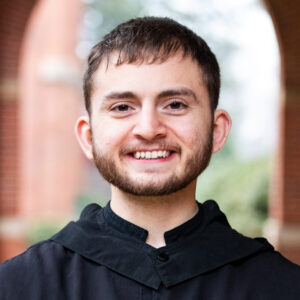
Br. Chrysostom Sica professed junior vows in January 2022. His duties include serving as Master of Ceremonies, playing organ for festal masses during the week, taking care of the garden, working in the college, and studying philosophy. Hailing from Moscow, Pennsylvania, he is militantly proud of his northern heritage.

Written by chrysostomosb · Categorized: reflections

Sep 14 2023

Reflection for the Exaltation of the Holy Cross

This year, I had the privilege of accompanying the entrance antiphon of today’s Mass on the organ: “But it behooves us to glory in the Cross of our Lord Jesus Christ, in whom is our salvation, life, and resurrection, by whom we are saved and delivered.”

It is easy to take the Cross for granted. We forget how radical a symbol it is. Think of modern means of execution—less visibly barbaric, perhaps, but maybe because of that all the more dehumanizing. It’s easier to accept the state killing someone when we aren’t confronted directly with that person’s pain. But still, can you imagine glorying in the electric chair, or fatal injection?

Yet that is precisely what we are asked to do. We are asked to boast—be proud of—an instrument of torture and death, and the fact that the man whom we worship was subject to it. What does this tell us about Christ, and what does it tell us about the Christian life?

Hegel, in his work Phenomenology of Spirit, wrote about what he termed the “master-slave dialectic.” In simplistic terms, he argued that when a slave is subjected to a master, he becomes dependent on the master and defined by him: a slave has no rights of his own, his master has a right over his very existence (as Catholics, we believe in intrinsic rights, but Hegel is concerned with social realities). But in this process, the master is also defined by his slave: his power only has meaning when it is exercised over someone else. Ironically, he can only achieve the status of “master” because his slave exists.

It seems to me that we often approach God as though he ought to be Hegel’s master. In short, we believe he should demonstrate his power over us weak, fallen creatures, or rather, over those other weak, fallen creatures. We wonder how he can allow so much suffering and societal evil, and we wish the forces of good, whether we identify them as the Church, or the political party we subscribe to, or those who agree with us in everyday disputes, would seize power and define reality as we see it for those with whom we disagree. We think the world would be fixed that way.

But in today’s feast, God informs us otherwise. God is not Hegel’s master. God does not need us to demonstrate his power. His might is not defined by his lording it over us. Rather, he chose to triumph by embracing defeat. God conquered the world when it saw the Cross and believed that God had lost. As one of our Easter hymns puts it, “Our guilt is gone, sin’s reign is done, for conquered o’er the conquering won: his anguished death became death’s bane, Christ’s might and power unchanged remain.”

And Christ has called us to be like himself, showing us by the Cross that we ought to define ourselves, not by the power we exercise over others, but by our willingness to embrace suffering, loneliness, and shame for their sake. These become little crosses of our own, united to the one Cross of the Lord, our salvation, life, and resurrection, who by forsaking his power (Philippians 2:5-8) saved and delivered us. By these crosses we recognize that our glory is not in the power we exercise over others but in our union with our Redeemer’s sacrifice.

And so, the Exaltation of the Cross challenges us: are we willing to forsake the strength of the world to glory in the weakness of God? (1 Corinthians 1 :26-24)


Br. Chrysostom Sica professed junior vows in January 2022. His duties include serving as Master of Ceremonies, playing organ for festal masses during the week, taking care of the garden, working in the college, and studying philosophy. Hailing from Moscow, Pennsylvania, he enjoys soccer, chess, and lauding his northern heritage.

Written by chrysostomosb · Categorized: reflections

(704) 461-6675
Belmont Abbey
100 Belmont-Mt. Holly Rd
Belmont, NC 28012
©2026 BELMONT ABBEY MONASTERY | DESIGNED BY FUZATI
  • About Us
  • Vocations & Discernment
  • Apostolates
  • Donate
  • Schedule a Visit
  • Mass Schedule
  • Contact Us
Sponsoring
(704) 461-6675
Belmont Abbey
100 Belmont-Mt. Holly Rd
Belmont, NC 28012
©2026 BELMONT ABBEY MONASTERY
DESIGNED BY FUZATI

  • About Us
    • Our Monastery
    • Our Monks
    • Benedictines
  • Vocations
    • Discernment
    • Our Daily Life
    • Becoming a Monk
    • Vocations Questionnaire
  • Healthy Relationships Policy
  • Apostolates
    • Belmont Abbey College
    • The Oblates of St. Benedict
    • Benedictine Volunteer Corps
  • Schedule a Visit
  • Donate
  • News
  • Contact Us
Quick Links
  • DAILY SCHEDULE
  • LIVESTREAM MASS
  • VIDEOS
  • PRAYER REQUESTS
  • EVENTS
  • HOMILIES
  • NEWS